
Gallery: Miniature Trains

It's widely known that railroads played a major role in the development and growth of the Pine Belt at the turn of the 20th century. Trains captured the imagination of many children growing up during that time. Some of those youngsters became train aficionados as adults and passed their enthusiasm on to their offspring. These railfans (aka, ferroequinologists) were (and still are) passionate about the history, technology and cultural significance of all types of trains.
This gallery draws from our archives and spotlights examples in Hattiesburg of one particular train genre- the miniature train. These are not the model railways one might see under a Christmas tree. Rather, they're fully functional, scaled-down trains, many of which are capable of pulling cars large enough to transport individuals on suitable tracks.
As always, if you have any miniature train stories and/or photos from the Hattiesburg area, please contact HAHS so we can share them with our internet visitors.
Courtesy of David Sheley
Turner Family
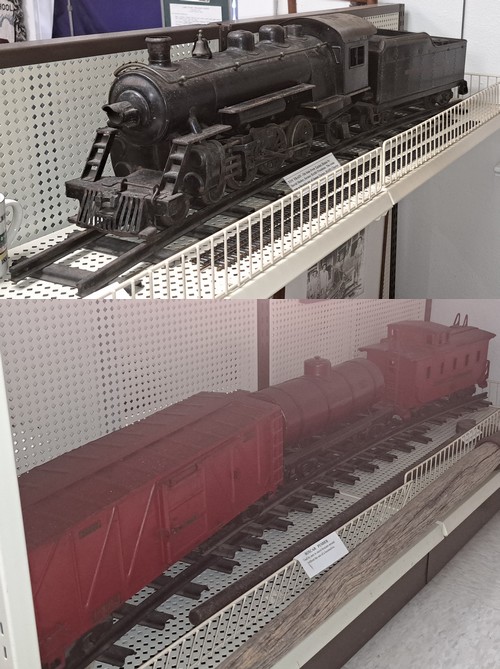
The HAHS is fortunate to have a miniature from the Turner family on display in our museum. The train was a favorite toy of James Turner (an HAHS charter member) who grew up in the family's Bay Street home.
The display includes the original engine, box cars, a caboose and a portion of track. Can you imagine the excitement that James' friends experienced when invited to his home in the early 1900's to enjoy a "real" train ride?
Stop by the museum during regular visiting hours to see this unique train for yourself.
his locomotive
Esco Simmons
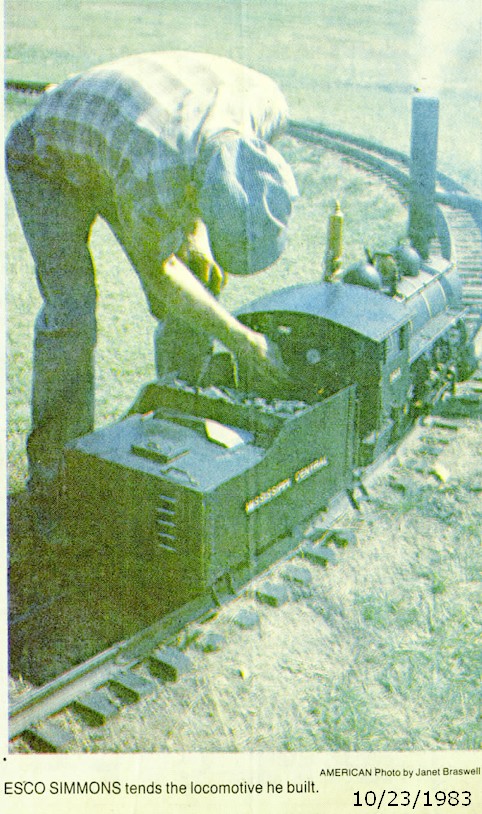
Esco Simmons built his own miniature engine (Engine 2803) modeled after a 1933 Mississippi Central Engine (#142). Simmons' locomotive was forged intermittently over six years and was created with scrap iron from the (then) Shemper Salvage Yard. The track (presumably located in his backyard) formed a circle complete with a trestle; the railway was also created with salvaged rails from the Shemper facility.
Simmons began work on his engine at his automotive transmission repair shop on Bouie Street. Very little money went into his project; the same could not be said of man-hours. At the time of the 1983 Hattiesburg American article, his future plans included the fabrication of coaches and a caboose. For the time being, the neighborhood children had to be satisfied enjoying the sight and the smells of engine 2803 as it travelled around the handcrafted Simmons Railroad Line (Hattiesburg American: 10/23/1983).
Smith & E. G. Parkman, 1978
T. L. Smith
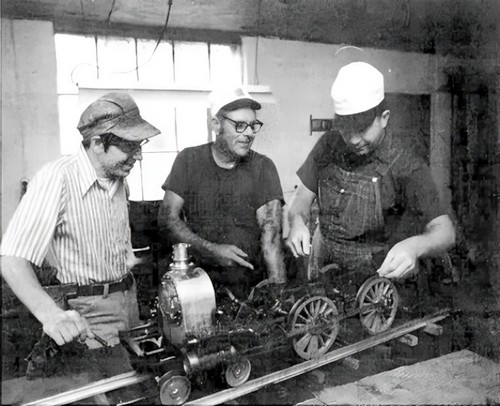
T. L. Smith (center in photo) is shown in his shop building a scale model of an American-style coal-burning train designed over 100 years ago.
All three men in the photo were members of the Brotherhood of Live Steamers, a national organization dedicated to building working scale models of live steam train engines (Hattiesburg American: 10/15/1978).
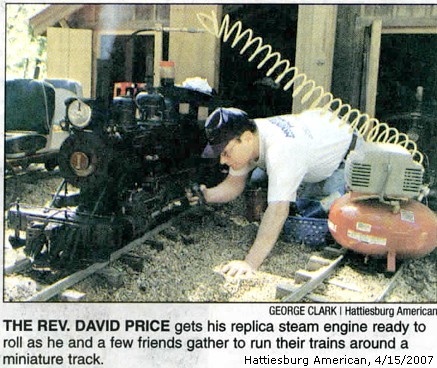
steam engine
David Price
Rev. David Price spent ten years custom-machining and assembling his replica steam engine. In a 2007 Hattiesburg American article, Price said, "Steam locomotives have a whole different sort of appeal than diesel. They represent a time when the train was the fastest thing around."
Given his knowledge of and background with steam engines, David was placed in charge of cosmetic restorations to the two full-sized locomotives and baggage car that reside next to the historic downtown Hattiesburg depot (Hattiesburg American: 4/15/2007).
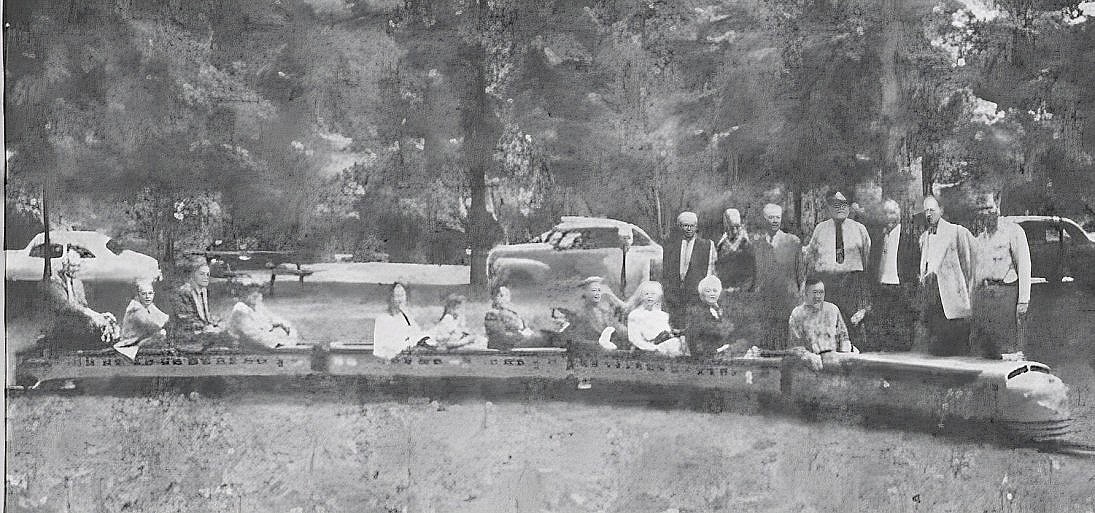
members, city officials and others pose with
the 1953 train
Kamper Park and Zoo: 1950's
Perhaps the best-known and most beloved miniature trains in Hattiesburg are those seen over the years at Kamper Park. The first train appeared in 1953 through the efforts of the Hattiesburg Exchange Club.
At the time of the train's dedication, a tunnel was being constructed. A train station was in place, and all that was needed was minor painting. Andrew Carroll, chair of the train committee, described the station as having a white roof and "shocking pink" sides (Hattiesburg American: 4/3/1953).
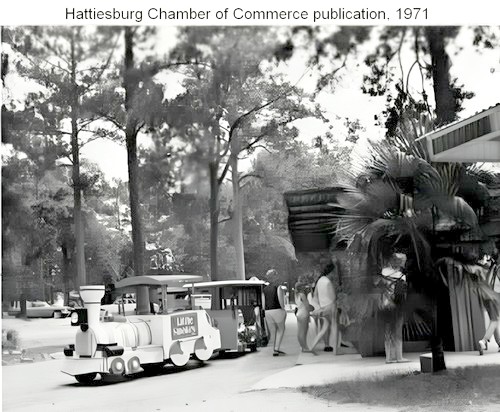
Kamper Park and Zoo: 1960's
The park's original children's train provided many years of service, but was eventually retired given its tendency to jump its tracks (Hattiesburg American: 9/12/1963). A new train, "Little Smokey," made its appearance in 1964. It was a four-coach, rubber-tired, gasoline "train" capable of carrying approximately 40 children. Since it required no tracks, its route through the park was fairly optional (Hattiesburg American: 2/22/1964). This photo from a 1971 Chamber of Commerce publication shows the train with park visitors standing next to it.
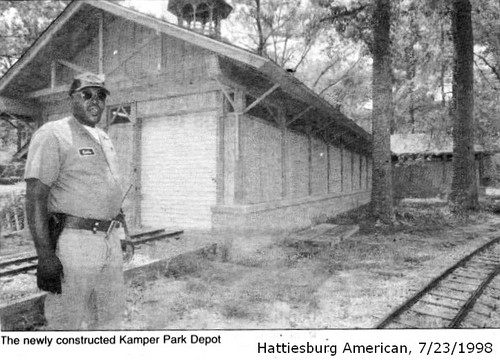
new depot in 1998

"train lady"
in 1991
Kamper Park and Zoo: 1991
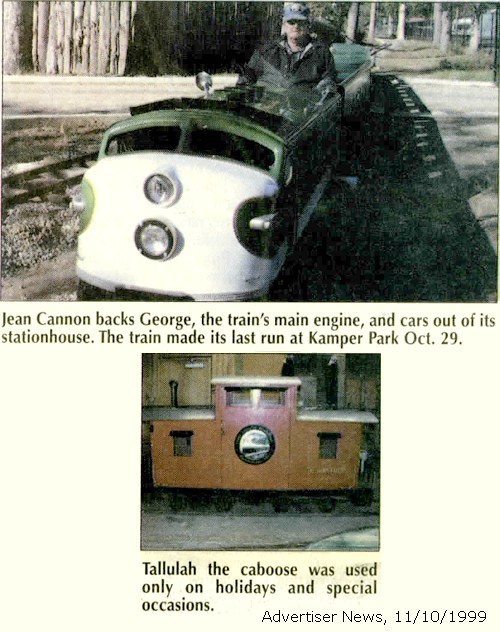
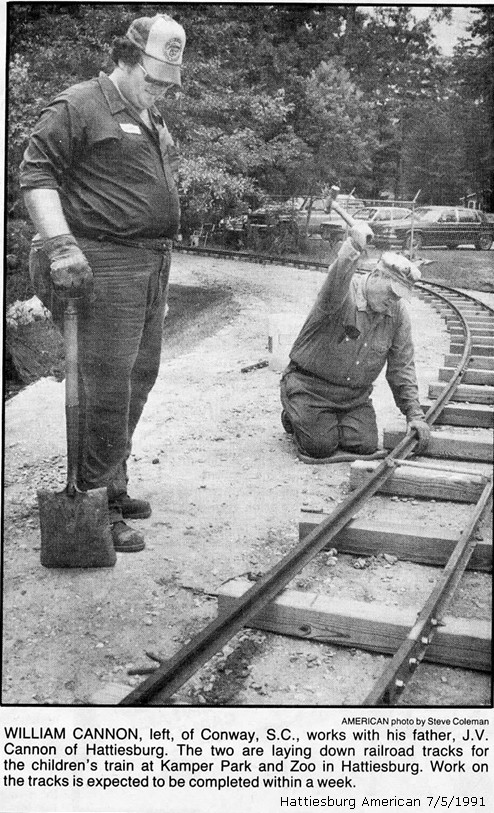
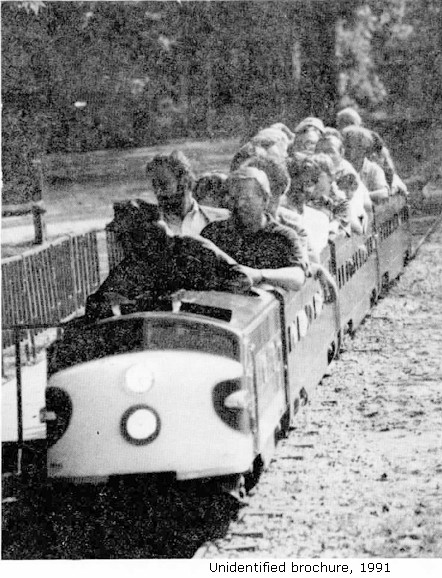
Another Kamper Park train (this one with a track) appeared in 1991. The city contracted with J. V. Cannon and his wife, Georgia, to construct and run the train which they purchased from the Greenville, SC City Park.
The train was modeled after the old Southern Railway line. It used an authentic 16-gauge locomotive equipped with a Wisconsin air-cooled engine built in 1950. Two engines were actually used interchangeably so the train could continue operations even during maintenance intervals.
Local children knew Mrs. Cannon as "the train lady." She served as conductor for the Little Lines of Mississippi (the Cannon's railroad company name) and shared stories with passengers about the train itself and anecdotes about the animals seen as the train circled the park (Hattiesburg American: 6/17/1997).
Little Lines of Mississippi ceased operations in 1999 when The Cannons retired to South Carolina and took the train with them. While in the Hub City, the train was estimated to have traveled over 18,000 miles on its 1/2 mile track and carried some 486,000 passengers (Advertiser News, 11/10/1999).
Kamper Park and Zoo: 2000 and 2022
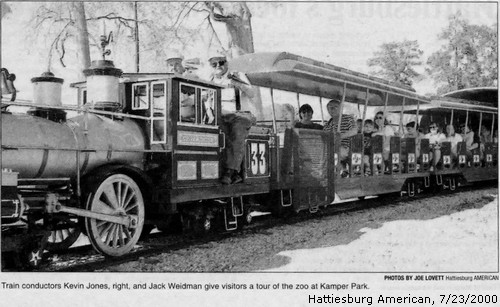
The Kamper facility's next train was a larger, 24-gauge version purchased from a facility in Arkansas. Engine 33 went into service in 2000 and continued providing visitors with both a tour of the park and the fun of experiencing a train ride, albeit on a miniature scale (Hattiesburg American: 7/23/2000).
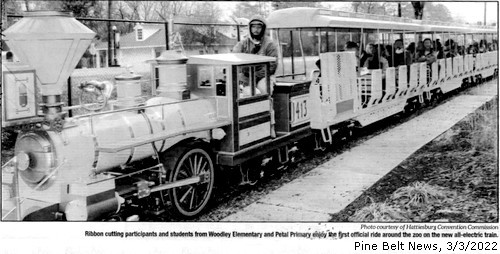
Engine 33 remained on display at Kamper Park in 2022 and was fired up on special occasions when attendance was higher than usual. A newer electric engine, however, was added that year and currently provides the primary tour for guests. Engine 413 was purchased from Chance Rides of Wichita, KS and represents a significant savings in terms of both maintenance and operations. Mississippi Power Co. partnered with the city of Hattiesburg at the new train's dedication (Pine Belt News, 3/3/2022).
Postscript
at Kamper Park
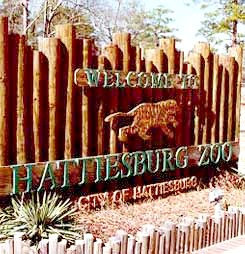
In addition to a memorable train ride, there's a variety of things for the entire family to see and do at Kamper Park and the Hattiesburg Zoo at Kamper Park; use these links for more information.